
Security for our staff
Working safely in high-risk countries
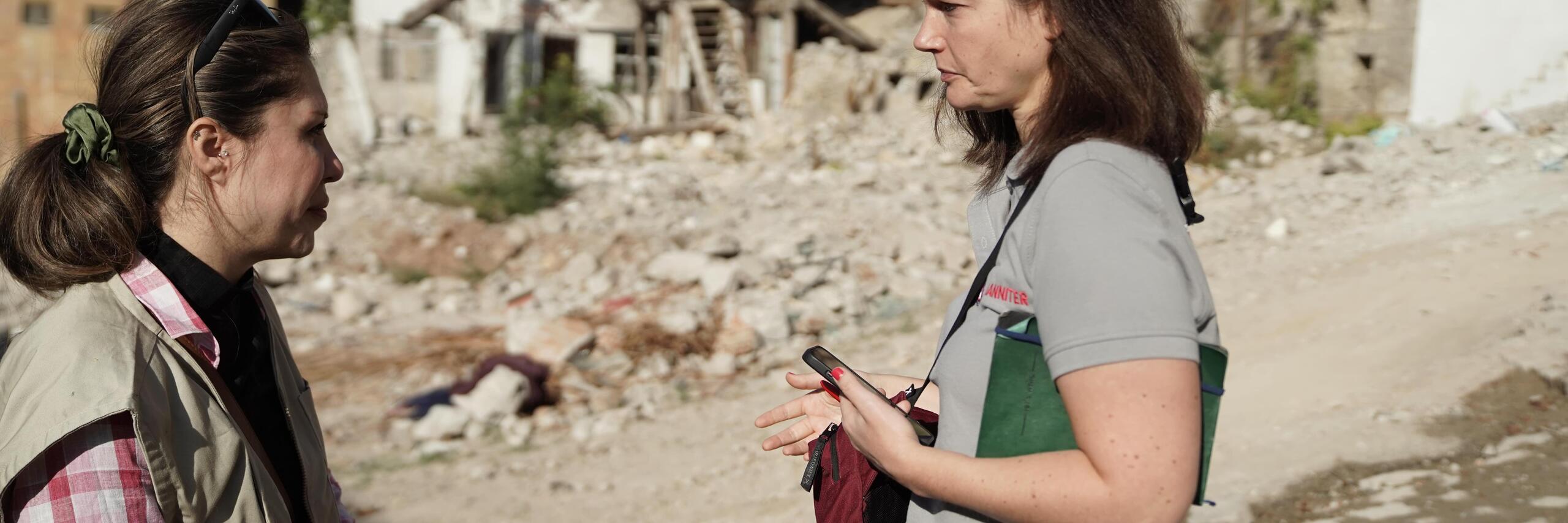
In regions where they are most needed, our employees are often exposed to danger. To protect them, internal security experts monitor the situation. Incidents in which aid workers find themselves in dangerous situations are becoming more frequent worldwide. This applies to missions following natural disasters such as floods, earthquakes and epidemics, but also to dangers such as gunfire or kidnapping in armed conflicts.
Security officer Florian Meyer has an overview of the global situation at the federal office in Berlin. He maintains contact with colleagues in the regional offices, advising and supporting them. Meyer and his colleagues focus primarily on preventive measures. They are always well informed and draw up detailed security plans based on risk analyses. These plans regulate how and where employees are allowed to move around locally, how offices and accommodation must be protected, and how communication is to be handled.
Safety is our responsibility to those who work every day for the well-being of others.”
Prepared for emergencies
To keep our people as safe as possible, we focus on being fully prepared and keeping up with training. A key part of our safety strategy is practical training, like HEAT (Hostile Environment Awareness Training) courses. These get our international staff ready for working in risky places. We also offer tailor-made safety training courses for our national employees, which are adapted to the specific challenges of their regions of operation. These training courses teach important skills for minimising safety-related risks and ensuring a safe working environment. We pay particular attention to our local partners, as they are often exposed to high risks. ‘We understand safety as a collective responsibility,’ says Florian Meyer.

Rose Munene, PMEAL coordinator in Mozambique, attended her first HEAT safety training course in Kenya in August 2024. Here she reports about her experience.
Rose, when was the last time you completed security training?
I recently took part in a three-day security training course (Personal Field Security Training), which consisted of a series of theoretical and practical modules as well as simulations. The course took place at the Humanitarian Peace Support School in Nairobi, Kenya. It was the first time I had taken part in such training.
Why was this training important for your work and for you personally?
This course was very important for me because it helped me prepare for my assignment in a conflict zone (Cabo Delgado province in Mozambique). I learned to recognise, assess and manage risks in this challenging environment. I gained a fundamental understanding of how to ensure my personal safety. It is important to take individual responsibility, consciously control my behaviour and observe that of others, and adhere to the basics of security management.
What were the most important insights you gained?
Most of the modules were important to me: firstly, recognising risks in buildings so that I can react appropriately in an emergency. Secondly, under which circumstances a kidnapping could occur and what measures I can take to survive it. Thirdly, knowing how to react in stressful situations, how to recognise them and how to prevent them. Fourthly, the rules of first aid in dangerous environments.