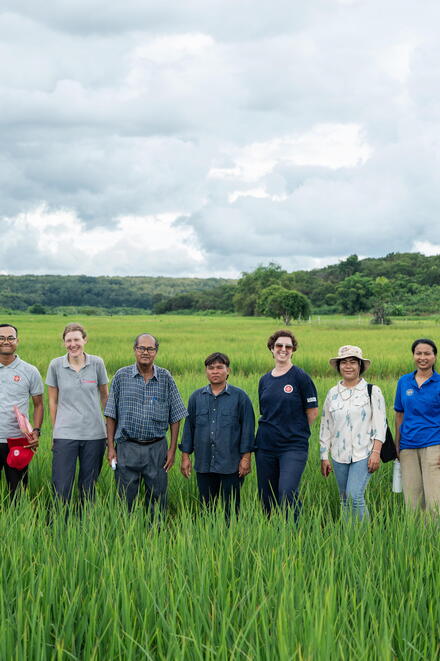

Staff
Taking part in change
Restructuring of Johanniter 2025
For our employees in the country offices and at our Berlin headquarters, the year 2025 was marked above all by the development and implementation of our new global structure.
It was clear from the start: The changes ahead are extensive and pose a challenge for everyone. To keep employees informed in a transparent manner about what is planned and when, a clear change and communication plan was developed. After all, having a sense of direction amid change is crucial.
Thanks to newsletters, discussion forums, digital town halls with updates on milestones, and structured feedback loops, all colleagues knew at all times where we stood and what steps would follow. “Change can only succeed if employees understand why it’s happening and the path we’re taking together. Transparency is our most powerful tool for this,” emphasizes Hannah Valère, Head of Human Resources.
Employees played an active role in shaping the process. In international working groups, they collaboratively developed roles and responsibilities, as well as redefining cooperation between the levels of the organisation's offices in different countries, regions and the federal level. The overarching goal was to prepare the organisation for the future, enabling it to provide high-quality humanitarian aid to people worldwide.
Meanwhile, our leaders continued to foster a people-centred organisational culture that promotes respect, transparency, and accountability. This included introducing a uniform global compensation system that promotes fairness, comparability and mobility.
In the face of global challenges, we are impressed by our teams' resilience. Thanks to their dedication, aid reaches the places where it is needed most.
New organizational chart
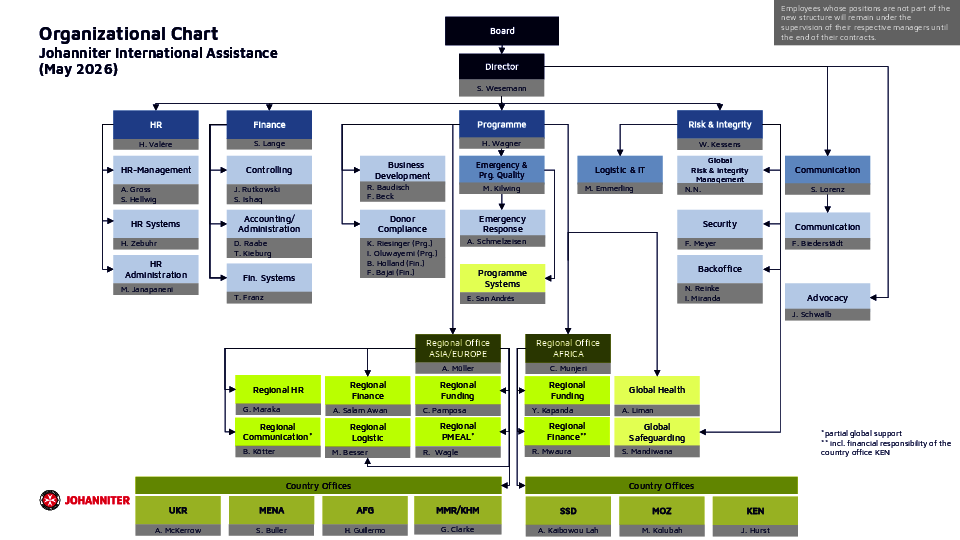
This is how employees experienced the change process
A Shared Challenge
“It was a challenging process for everyone, but also a very important one. Together, we defined a new structure and new ways of working, which we are now implementing. The regular meetings were very helpful for clarifying roles, asking questions and sharing perspectives. When changes occur, it’s important to understand why they’re necessary and how they will improve our work. Open dialogue fostered this understanding. I helped to define the processes for fundraising and donor relations. I also contributed to shaping the new regional structure for Africa. The changes we’ve implemented ensure that we can adapt to new conditions and work more efficiently with fewer resources. At the same time, we have shifted more decision-making authority to the countries and created a clearer regional structure. This transformation will enable us to continue pursuing the goals of our strategy efficiently in future.”

“The change process has had a direct impact on both my daily tasks and my role in the Human Resources department here in the region. The restructuring led to the establishment of a regional office within the new organisational structure at my workplace in Amman, necessitating the adaptation of numerous processes. While the changes brought uncertainty, they also created many opportunities. We rethought many things and evaluated what works best. As part of this process, I supported the communication and change management areas by answering employees' questions and addressing their feedback, and by fostering open dialogue. I greatly value transparency and open communication. I have been working for Johanniter for more than seven years. It was therefore difficult for me to witness colleagues leaving the organisation and offices being closed. However, I knew that this change was necessary. I have confidence in the organisation’s new direction, and I am optimistic and motivated. However, I also recognise that we must continue to learn and adapt.”
2025 at a glance
Protection as a guiding principle of our work

'Safeguarding' means that, in accordance with international standards and beyond, we are committed to protecting the physical and psychological well-being of everyone who comes into contact with our work. To this end, we implemented a wide range of measures in 2025.
For instance, we have systematically incorporated safeguarding principles into all project activities. 'To effectively protect people, we consider this issue from the outset of every project,' explains Safeguarding Advisor Samuel Maniwana. In Mozambique, for instance, we revised relevant staff documents, while in Ecuador we reviewed guidelines and structures, addressing any gaps. Audits provided insights into what still needs to be done on the ground. New HR procedures were also introduced, such as background checks and verification of safeguarding knowledge.
In addition, 320 new and existing staff members were trained. During these sessions, participants learned about the relevant guidelines and measures designed to prevent sexual exploitation, abuse and harassment, as well as the protection mechanisms available to victims of gender-based violence. Other topics included the Johanniter Code of Conduct, how to use feedback mechanisms, and how to report complaints and incidents involving suspected misconduct.
For Johanniter, registration in the CHS Alliance’s reporting scheme is a milestone. “This is where organizations publish information about cases of sexual exploitation, abuse, and harassment. This contributes to our accountability and supports the prevention of such cases across the entire sector,” explains Mandiwana.
To consistently implement safeguarding in our work, the responsible colleagues at the country offices regularly discuss their experiences, challenges, and potential solutions. Starting in 2026, Mandiwana and his team will roll out an organization-wide e-learning course on safeguarding, which will then also be available to partner organizations.
We consider how we can effectively protect people from the very beginning of everything we do.
Strengthening people. Worldwide.
Discover More TopicsLearn how Johanniter has supported 2,025 people in crisis situations: from emergency relief and healthcare to income and food security. Effective, collaborative, and transparent.